
Accounting for sampling bias reveals a decline in abundance of endangered false killer whales in the main Hawaiian Islands.
Endangered Species Research. 2025.
57:325–340
More details
Collapse details
Date Published:
Publication:Ocean:Region:Species:Methods:
- January 1, 2025
Volume contents Endang Species Res 57:325-340 (2025) DOI: https://doi.org/10.3354/esr01423 copied Accounting for sampling bias reveals a decline in abundance of endangered false killer whales in the main Hawaiian Islands Janelle J. Badger Robin W. Baird Devin S. Johnson Amanda L. Bradford Sabre D. Mahaffy Michaela A. Kratofil Tori Cullins Jens J. Currie Stephanie H. Stack Erin M. Oleson ABSTRACT: We estimated abundance of the endangered main Hawaiian Islands (MHI) insular population of false killer whales Pseudorca crassidens from 1999-2022 using a modeling technique that incorporates animal availability in a capture-recapture analysis. The population was sampled using different sampling methods, resulting in yearly encounter histories of 265 individuals and 53 satellite-tagged whales. Survey effort and animal location data were separately analyzed using kernel density estimators, and the degree of overlap between these 2 processes was used to model detection probability in a Bayesian Jolly-Seber population model. This approach better addresses spatiotemporally variable sampling effort than traditional capture-recapture methods, improving the estimation of reliable abundance trends. Using simulated data, the model was robust to many sampling and ecological complications, such as variable low detectability, unequal tag deployment lengths, and variable social group sizes. Fitting the model to the MHI false killer whale data set, we found that the insular population of false killer whales remains small, with an estimated 139 individuals (95% credible interval, CRI = [114, 162]) in 2022. The population appears to be in decline throughout the study period, with a mean annual percent change of -1.09 (95% CRI = [-2.11, -0.023]) over the entire time series and -3.51 (95% CRI = [-5.08, -1.88]) since 2013, when the population was listed as endangered. Given the magnitude of the decline, identifying which of the many factors affecting this population is most responsible is key in order to guide potential management responses.
Loggerhead turtle Caretta caretta density and abundance in Chesapeake Bay and the temperate ocean waters of the southern portion of the Mid-Atlantic Bight.
Endangered Species Research. 2018.
37: 269-287
More details
Collapse details
Date Published:
Publication:Ocean:Region:Species:Methods:
- December 13, 2018
We conducted aerial surveys of sea turtles in 2011 and 2012, incorporating corrections for perception and availability bias in Chesapeake Bay and near-shore continental shelf waters of the Mid-Atlantic Bight off the US states of Virginia and Maryland. Results of these surveys and ancillary research to determine surface times for loggerhead turtles provide us with a new baseline population estimate for turtles in the region. Prior surveys were conducted in Chesapeake Bay in the mid-1980s and early 2000s, and in ocean waters in the late 1970s and early 1980s. Although comparison of density estimates not corrected for availability between prior surveys and this effort suggests that the population of sea turtles, especially loggerhead turtles, is higher than previous estimates, differences between surveys may be the result of survey methodologies and cannot be assumed to be true changes in density. Surface time for availability corrections was calculated using dive summaries from satellite telemetry on 27 loggerhead turtles tracked between 2011 and 2015. We calculated stratified seasonal availability corrections for bay and ocean waters based on assumed differences in turtle behavior and water clarity between the 2 habitats. For each habitat, we provided seasonal corrections for 3 detection depth bins (shallow, moderate, and deep) to account for differences in sub-surface detection ranges. Differences and trends toward differences among availability corrections underscore the need to better understand the many variables that affect surface time for sea turtles in temperate waters, and the effect that availability has on abundance and density estimates.
Habitat models and assessment of habitat partitioning for Kemp's ridley and loggerhead marine turtles foraging in Chesapeake Bay (USA).
Endangered Species Research. 2022.
47:91-107
More details
Collapse details
Date Published:
Publication:Ocean:Region:Species:Methods:
- February 10, 2022
Understanding the spatial distribution of a species is required to enact effective conservation. Complications to effective conservation can arise when the distributions of multiple target species are non-overlapping. Conservation efforts meant to protect one species may shift threats into the distribution of another species. Two species of marine turtle, loggerhead Caretta caretta and Kemp’s ridley Lepidochelys kempii, are common seasonally in Chesapeake Bay, a large estuary on the US east coast. Both species are protected under the US Endangered Species Act and face spatially complex threats in the region. We created habitat suitability models for these 2 species to inform conservation efforts in the region and explore the extent of overlap between their distributions. Argos satellite tags were deployed on 24 Kemp’s ridley and 10 loggerhead turtles to record animal locations within the Bay. Boosted regression tree models were created for each species using presence-only animal locations, predicting suitable habitat within the Bay. Habitat for Kemp’s ridley turtles was predicted in shallow, coastal areas of the southern Bay as well as in brackish areas of rivers. Loggerhead turtle habitat was predicted to extend farther north than Kemp’s ridley habitat and was generally found in deeper areas of the middle Bay. There is some evidence that these 2 species are partitioning habitat. Any conservation measures adopted to conserve marine turtles in the Chesapeake Bay should consider the habitat of both species holistically to avoid shifting impacts from one species to another.
Sea turtle density surface models along the United States Atlantic coast.
Endangered Species Research. 2024.
53:227–245
More details
Collapse details
Date Published:
Publication:Ocean:Region:Species:Methods:
- February 29, 2024
Spatially explicit estimates of marine species distribution and abundance are required to quantify potential impacts from human activities such as military training and testing, fisheries interactions, and offshore energy development. There are 4 protected species of sea turtle (loggerhead, green, Kemp’s ridley, and leatherback) commonly found along the east coast of the USA, our study area, and which require impact assessments.
Passive acoustic monitoring reveals spatiotemporal segregation of two fish-eating killer whale Orcinus orca populations in proposed critical habitat.
Endangered Species Research. 2021.
44:253-261. https://doi.org/10.3354/esr01099
More details
Collapse details
Date Published:
Publication:Ocean:Region:Species:Methods:
- January 1, 2021
We used passive acoustic monitoring at 15 sites along the coast of Washington State, USA, to assess habitat use patterns of 2 sympatric populations of fish-eating killer whales Orcinus orca: northern residents (NRKW) and southern residents (SRKW).
False killer whales and fisheries in Hawaiian waters: evidence from mouthline and dorsal fin injuries reveal ongoing and repeated interactions.
Endangered Species Research. 2024.
55:273–293
More details
Collapse details
Date Published:
- December 18, 2024
Found: a missing breeding ground for endangered western North Pacific humpback whales in the Mariana Archipelago.
Endangered Species Research. 2020.
41:91-103
More details
Collapse details
Date Published:
- January 1, 2020
Identifying social clusters of endangered main Hawaiian Islands insular false killer whales.
Endangered Species Research. 2023.
51:249–268
More details
Collapse details
Date Published:
Publication:Ocean:Region:Species:Methods:
- August 3, 2023
The presence of distinct social groups within an animal population can result in heterogeneity in many aspects of its life history and ecology. The ability to accurately assess social group membership increases with the number of times individuals are identified, but obtaining sufficient sightings of rarely encountered species can be difficult. Three social clusters were previously identified for the endangered population of false killer whales Pseudorca crassidens around the main Hawaiian Islands, using modularity among associations within a 12 yr photographic dataset with no restrictions on the number of times seen. In this study, we used photo-identification data over a 23 yr period to reassess the number and membership of social clusters, restricted to individuals seen on at least 5 different days. We compared the robustness of clustering assignments from 6 community detection algorithms using modularity and found that the 3 highest-ranking algorithms all identified the same number (4) and membership of social clusters. Spatial use of clusters varied among the islands, with 3 of the 4 clusters encountered regularly only off 1 or 2 of the 3 main island study areas. Comparison of genetic differentiation among social clusters revealed significant differentiation in nuclear DNA. Furthermore, all individuals in 2 of the clusters possess the same mitochondrial DNA haplotype, while in the other 2 clusters, approximately 40% of animals possess a second haplotype. This level of clustering and associated heterogeneity within the population may have implications for mark−recapture abundance estimation, as well as for mitigating exposure to anthropogenic activities, including interactions with fisheries.
Calls of North Atlantic right whales Eubalaena glacialis contain information on individual identity and age class.
Endangered Species Research. 2026.
30:157-169
More details
Collapse details
Date Published:
Publication:Ocean:Region:Species:Methods:
- March 2, 2026
Passive acoustic monitoring is a powerful tool that allows remote detection of marine mammals through their vocalizations. While call detection provides information on species presence, additional information may be contained within the vocalizations that could provide more information regarding the demographics and/or number of individuals in a particular area based on passive acoustic detections. The North Atlantic right whale Eubalaena glacialis produces a stereotyped upswept call, termed the upcall, that is thought to function as a long-distance contact call in this species. As such, the call is likely to contain cues providing information about the individual producing it. The goal of this study was to test whether the right whale upcall could potentially encode information related to the identity and age of the caller. Using upcalls recorded from 14 known individuals through non-invasive suction cup archival acoustic tags, we demonstrate that the upcall does contain sufficient information to discriminate individual identity and age class, with average classification levels of 72.6 and 86.1%, respectively. Parameters measured from the fundamental frequency, duration, and formant structure were most important for discrimination among individuals. This study is the first step in demonstrating the feasibility of obtaining additional data from passive acoustic monitoring to aid in the conservation efforts for this highly endangered species.
Spatial and seasonal patterns in acoustic detections of sperm whales Physeter macrocephalus along the continental slope in the western North Atlantic Ocean.
Endangered Species Research. 2018.
35:1-13
More details
Collapse details
Date Published:
Publication:Ocean:Region:Species:Methods:
- January 1, 2018
In the present study, we conducted multi-year passive acoustic monitoring to assess year-round sperm whale occurrence along the continental slope between Florida and New England, USA. Between 2011 and 2015, we collected 2037 d of recordings using bottom-mounted recorders deployed at 5 sites. We analyzed these recordings for sperm whale echolocation clicks, which were detected commonly between New England and North Carolina, but infrequently off the coast of Florida.
Complete
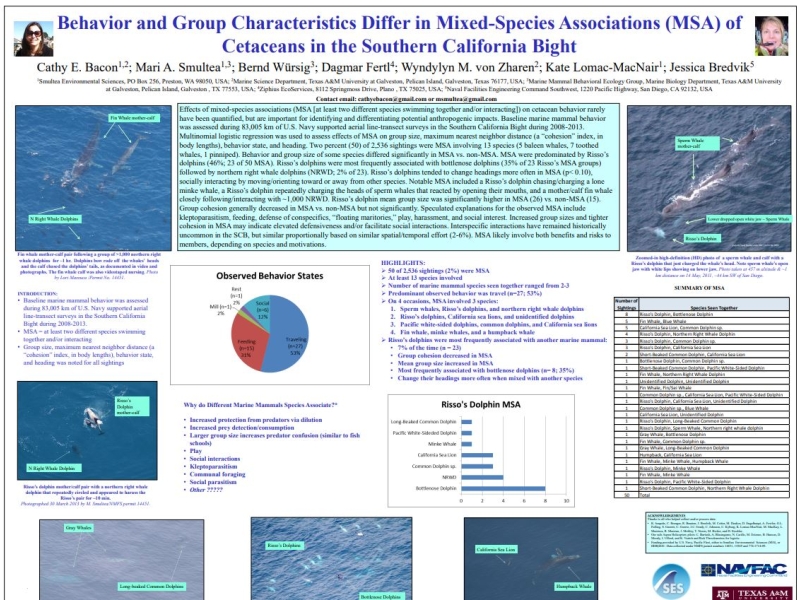
Aerial Surveys of Marine Mammals Conducted in the Inland Puget Sound Waters of Washington, summer 2013 – winter 2016
Project Objectives
1) Conduct aerial surveys during four seasonal periods within the inland Puget Sound Survey Area to assess potential differences in seasonal distribution, numbers, and behavioral state patterns of marine mammals; 2) Collect data to estimate densities of marine mammals in the inland Puget Sound waters for species with sufficient sightings; 3) Estimate abundance for each marine mammal species seen an adequate number of times; 4) Document the distribution and habitat use of each species observed; 5) Document and describe behaviors seen without performing focal follows.
Complete
Satellite Tagging and Behavioral Monitoring of Male California Sea Lions in the Pacific Northwest to Assess Haul-out Behavior on Puget Sound Navy Facilities and Foraging Behavior in Marine Navy Testing and Training Areas
Project Objectives
To determine the abundance and habitat use of California sea lions that haul out at Navy facilities and forage in testing and training areas
Complete
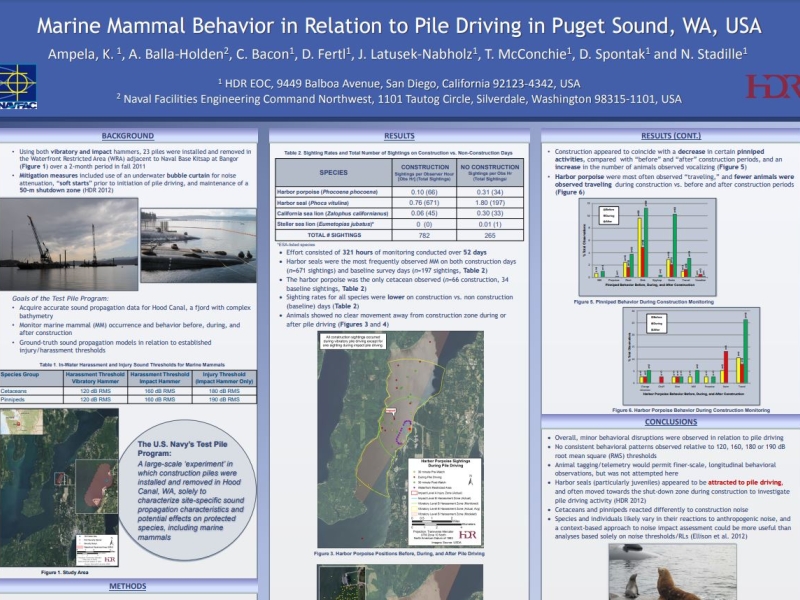
Vessel-based Marine Mammal Surveys in Puget Sound, Washington
Project Objectives
Conduct marine mammal in-water vessel-based line transect surveys in the Puget Sound basin to: 1) Record data on all marine mammal species seen with the study area, with a focus on the killer whale (Orcinus orca) and the harbor porpoise (Phocoena phocoena). 2) Identify the seasonal occurrence and abundance/density of cetaceans within the study area. 3) Identify the effects of environmental variables on the distribution and abundance of species in the study area.No related blog posts to display