
More details
Collapse details
Date Published:
- October 6, 2008
- 4,370.34 KB
Identification of western North Atlantic odontocete echolocation click types using machine learning and spatiotemporal correlates.
PLOS One. 2022.
17(3): e0264988
More details
Collapse details
Date Published:
Publication:Ocean:Region:Species:Methods:
- March 24, 2022
A combination of machine learning and expert analyst review was used to detect odontocete echolocation clicks, identify dominant click types, and classify clicks in 32 years of acoustic data collected at 11 autonomous monitoring sites in the western North Atlantic between 2016 and 2019. Previously-described click types for eight known odontocete species or genera were identified in this data set: Blainville’s beaked whales (Mesoplodon densirostris), Cuvier’s beaked whales (Ziphius cavirostris), Gervais’ beaked whales (Mesoplodon europaeus), Sowerby’s beaked whales (Mesoplodon bidens), and True’s beaked whales (Mesoplodon mirus), Kogia spp., Risso’s dolphin (Grampus griseus), and sperm whales (Physeter macrocephalus)
More details
Collapse details
Date Published:
Filesize:
- November 1, 2019
This project is intended to provide baseline information on the species composition, density, distribution, and basic behavior of marine mammals and sea turtles present within the United States (U.S.) Navy’s Virginia Capes (VACAPES) Operating Area (OPAREA). This study is part of a larger, multi-institutional, marine mammal and sea turtle monitoring program of U.S. Navy range complexes along the U.S. Atlantic Coast and Gulf of Mexico supporting Atlantic Fleet Training and Testing (AFTT)
- 4,083.79 KB
Habitat utilization by beaked whales in the western North Atlantic Ocean using passive acoustics.
Marine Ecology Progress. 2025.
754:137-153
More details
Collapse details
Date Published:
- February 13, 2025
More details
Collapse details
Date Published:
Filesize:
- July 1, 2019
Taking into consideration the multiple intermediate scientific objectives in the U.S. Navy’s Strategic Planning Process (DoN 2013b), the goals of this study are to assist the U.S. Navy and regulatory agencies with environmental planning and compliance by addressing the following questions: Which cetacean species occur over the outer continental shelf to the east of NSN, and how does occurrence fluctuate seasonally? What are the baseline behaviors and ecological relationships of offshore cetaceans within the study area? Do individual cetaceans exhibit site fidelity within specific regions of the study area over periods of weeks, months, or years? What is the seasonal extent of cetacean movements within and around U.S. Navy VACAPES training range boxes? Do cetaceans spend significant time within or primarily
- 6,402.34 KB
More details
Collapse details
Date Published:
Filesize:
- April 1, 2020
Taking into consideration the multiple intermediate scientific objectives in the U.S. Navy’s Strategic Planning Process (DoN 2013b), the goals of this study are to assist the U.S. Navy and regulatory agencies with environmental planning and compliance by addressing the following questions: Which cetacean species occur over the outer continental shelf to the east of NSN, and how does occurrence fluctuate seasonally? What are the baseline behaviors and ecological relationships of offshore cetaceans within the study area? Do individual cetaceans exhibit site fidelity within specific regions of the study area over periods of weeks, months, or years? What is the seasonal extent of cetacean movements within and around U.S. Navy VACAPES training range boxes? Do cetaceans spend significant time within or primarily
- 9,368.29 KB
More details
Collapse details
Date Published:
Filesize:
- January 1, 2018
Passive acoustic monitoring was conducted using High-frequency Acoustic Recording Packages (HARPs) deployed in waters offshore of Virginia, North Carolina, and Florida with support from the US Navy during 2016 - 2017. The HARPs recorded underwater sounds between 10 Hz and 100 kHz. Data analysis consisted of analyst scans of long-term spectral averages (LTSAs) and spectrograms, and automated computer algorithm detection when possible. Three frequency bands were analyzed for marine mammal vocalizations and anthropogenic sounds: (1) Lowfrequency, between 10-1000 Hz, (2) Mid-frequency, between 1,000-5,000 Hz, and (3) Highfrequency, between 1-100 kHz.
- 5,208.04 KB
- Blue whale
- Bryde's whale
- Fin whale
- Minke whale
- North Atlantic right whale
- Sei whale
- Atlantic white-sided dolphin
- Blainville's beaked whale
- Bottlenose dolphin
- Clymene dolphin
- Common dolphin
- Goose-beaked whale
- Dwarf sperm whale
- False killer whale
- Gervais' beaked whale
- Killer whale
- Northern bottlenose whale
- Risso's dolphin
- Rough-toothed dolphin
- Short-finned pilot whale
- Sowerby's beaked whale
- Sperm whale
- Spotted dolphin
- Striped dolphin
More details
Collapse details
Date Published:
Filesize:
- February 1, 2016
The primary objectives of the passive acoustic 26 monitoring program are to: 1) Determine the patterns of occurrence at each monitoring site; 2) Compare patterns of occurrence to better understand distributional patterns; and 3) Document species-specific characteristics of the vocalizations of marine mammal species 30 in each area.
- 9,348.40 KB
More details
Collapse details
Date Published:
Filesize:
- August 17, 2016
A High-frequency Acoustic Recording Package (HARP; Wiggins and Hildebrand 2007) was deployed between May 2013 and March 2014 in the Cape Hatteras, NC, survey area at Site A in 970 m. This HARP sampled continuously at 200 kHz and recorded for 290 days between 29 May 2013 and 15 March 2014. The data were divided into three frequency bands (10 Hz – 1000 Hz, 500 Hz – 5000 Hz, and 1 kHz – 100 kHz) and scanned for marine mammal vocalizations using Long-Term Spectral Averages (LTSAs) and automated detectors. Vocalizations of blue whales, fin whales, minke whales, sei whales, North Atlantic right whales, humpback whales, Kogia spp., Risso’s dolphins, sperm whales, Cuvier’s beaked whales, Gervais’ beaked whales, Blainville’s beaked whales, possible Sowerby’s beaked whales, and unidentified delphinids were detected in the data.
- 2,842.35 KB
More details
Collapse details
Date Published:
Filesize:
- August 16, 2016
A High-frequency Acoustic Recording Package (HARP; Wiggins and Hildebrand 2007) was deployed between June 2014 and April 2015 in Norfolk Canyon, VA, at Site A in 982 m. This HARP sampled continuously at 200 kHz and recorded for 290 days between 19 June 2014 and 5 April 2015. The data were divided into three frequency bands (10 Hz – 1000 Hz, 500 Hz – 5000 Hz, and 1 kHz – 100 kHz) and scanned for marine mammal vocalizations using Long-Term Spectral Averages (LTSAs) and automated detectors. Vocalizations of blue whales, fin whales, minke whales, sei whales, humpback whales, Kogia spp., Risso’s dolphins, sperm whales, Cuvier’s beaked whales, Gervais’ beaked whales, possible Sowerby’s beaked whales, and unidentified delphinids were detected in the data.
- 2,844.76 KB
More details
Collapse details
Date Published:
Filesize:
- May 21, 2026
The U.S. Navy’s Jacksonville Range Complex (JAX) is located in the South Atlantic Bight offshore northeastern Florida and southeastern Georgia. From 2009 to 2020, passive acoustic monitoring was conducted using High-frequency Acoustic Recording Packages (HARPs) deployed across a depth gradient spanning the continental shelf and slope. Three sites were located on the shallow shelf (A–C; approximately 40–90 m), and one site was located on the continental slope (D; approximately 730–800 m). These long-term acoustic data provide a comprehensive assessment of marine mammal occurrence and ambient sound conditions across the region.
- 4,704.70 KB
More details
Collapse details
Date Published:
Filesize:
- May 20, 2026
From 2007 to2013,acomprehensive acoustic monitoring effort was conducted within the boundaries of the Onslow Bay study area to study marine mammal presence and ambient noise levels. The objective was to characterize the vocalizations of marine mammal species in the area, identify their seasonal presence patterns, and assess the potential impacts of naval operations on these species. This report presents the findings from the analysis of data collected using High-frequency Acoustic Recording Packages (HARPs; (Wiggins & Hildebrand 2007)), which were strategically deployed within the Onslow Bay study area across a shelf-to-slope gradient.
- 4,896.89 KB
More details
Collapse details
Date Published:
Filesize:
- May 20, 2026
From 2014 to2021, a comprehensive acoustic monitoring effort was conducted within the boundaries of the Virginia Capes Range Complex to study marine mammal presence and ambient noise levels. The objective was to characterize the vocalizations of marine mammal species in the area, identify their seasonal presence patterns, and assess the potential impacts of naval operations on these species. This report presents the findings from the analysis of data collected using six High-frequency Acoustic Recording Packages (HARPs; Wiggins & Hildebrand 2007), which were strategically deployed within the Virginia Capes Range Complex near Norfolk Canyon (Figure 1 & Table 1).
- 4,651.75 KB
More details
Collapse details
Date Published:
Filesize:
- June 1, 2020
Three High-Frequency Acoustic Recording Packages (HARPs) were deployed from June 2018 to September 2019 to detect marine mammal and anthropogenic sounds offshore in the Navy’s Virginia Capes Range Complex, approximately 44 nm northeast from Cape Hatteras (HAT).
- 10,035.71 KB
More details
Collapse details
Date Published:
Filesize:
- July 2, 2018
A High-Frequency Acoustic Recording Package (HARP) was deployed from April 2016 to June 2017 to detect marine mammal and anthropogenic sounds in the Navy’s Virginia Capes Range Complex offshore from Norfolk Canyon (NFC). The HARP was located 75 nm offshore in approximately 1000 m of water. The HARP recorded sound in the frequency band 10 Hz – 100 kHz. Data analysis consisted of analyst scans of long-term spectral averages (LTSAs) and spectrograms, and automated computer algorithm detection when possible. Three frequency bands were analyzed for marine mammal vocalizations and anthropogenic sounds: (1) Low-frequency, between 10-500 Hz, (2) Mid-frequency, between 10-5,000 Hz, and (3) High-frequency, between 1- 100 kHz.
- 4,807.47 KB
More details
Collapse details
Date Published:
Filesize:
- March 2, 2019
Two High-Frequency Acoustic Recording Packages (HARP) were deployed sequentially from May 2017 to June 2018 to record marine mammal and anthropogenic sounds in the Navy’s Virginia Capes Range Complex offshore ~ 44 nm northeast from Cape Hatteras (HAT).
- 11,290.13 KB
More details
Collapse details
Date Published:
Filesize:
- March 1, 2019
A High-Frequency Acoustic Recording Package (HARP) was deployed from June 2017 to June 2018 to detect marine mammal and anthropogenic sounds in the Navy’s Virginia Capes Range Complex offshore from Norfolk Canyon (NFC).
- 6,924.92 KB
More details
Collapse details
Date Published:
Filesize:
- June 2, 2020
A High-Frequency Acoustic Recording Package (HARP) was deployed from June 2018 to May 2019 to detect marine mammal and anthropogenic sounds in the Navy’s Virginia Capes Range Complex near Norfolk Canyon (NFC).
- 5,621.20 KB
More details
Collapse details
Date Published:
Filesize:
- June 3, 2020
Three High-Frequency Acoustic Recording Packages (HARPs) were deployed from June 2018 to September 2019 to detect marine mammal and anthropogenic sounds offshore in the Navy’s Virginia Capes Range Complex, approximately 44 nm northeast from Cape Hatteras (HAT).
- 10,035.71 KB
Effects of duty-cycled passive acoustic recordings on detecting the presence of beaked whales in the northwest Atlantic.
Journal of the Acoustical Society of America. 2026.
140(1):EL31-EL37
More details
Collapse details
Date Published:
Publication:Ocean:Region:Species:Methods:
- March 2, 2026
This study investigated the effects of using duty-cycled passive acoustic recordings to monitor the daily presence of beaked whale species at three locations in the northwest Atlantic. Continuous acoustic records were subsampled to simulate duty cycles of 50%, 25%, and 10% and cycle period durations from 10 to 60 min. Short, frequent listening periods were most effective for assessing the daily presence of beaked whales. Furthermore, subsampling at low duty cycles led to consistently greater underestimation of Mesoplodon species than either Cuvier's beaked whales or northern bottlenose whales, leading to a potential bias in estimation of relative species occurrence.
Using passive acoustic monitoring to document the distribution of beaked whale species in the western North Atlantic Ocean.
Canadian Journal of Fisheries and Aquatic Sciences. 2017.
74(12): 2098-2109. https://doi.org/10.1139/cjfas-2016-0503
More details
Collapse details
Date Published:
Publication:Ocean:Region:Species:Methods:
- December 1, 2017
Little is known about the ecology of many beaked whale species, despite concerns raised by mass strandings linked to certain sources of anthropogenic noise. Here, we used passive acoustic monitoring to examine spatial and temporal patterns in beaked whale occurrence at six locations along the continental slope in the western North Atlantic Ocean.
More details
Collapse details
Date Published:
Filesize:
- January 1, 2025
Long-term high-frequency acoustic recording packages (HARPs) at eight sites along the western North Atlantic shelf break.
- 1,276.05 KB
More details
Collapse details
Date Published:
Filesize:
- January 1, 2020
Long-term high-frequency acoustic recording packages (HARPs) at eight sites along the western North Atlantic shelf break.
- 1,430.35 KB
- Blue whale
- Fin whale
- Humpback whale
- North Atlantic right whale
- Sei whale
- Atlantic white-sided dolphin
- Blainville's beaked whale
- Bottlenose dolphin
- Common dolphin
- Goose-beaked whale
- False killer whale
- Gervais' beaked whale
- Killer whale
- Northern bottlenose whale
- Pilot whale
- Rough-toothed dolphin
- Short-finned pilot whale
- Sowerby's beaked whale
- Sperm whale
- Spotted dolphin
- Striped dolphin
- True's beaked whale
More details
Collapse details
Date Published:
Filesize:
- January 1, 2021
Long-term high-frequency acoustic recording packages (HARPs) at eight sites along the western North Atlantic shelf break.
- 2,135.09 KB
More details
Collapse details
Date Published:
Filesize:
- January 27, 2022
Over 25 species of cetaceans utilize the shelf break regions of the US eastern seaboard, including several endangered species. Understanding patterns in species distribution, and the anthropogenic and environmental drivers that may impact their distribution, are critical for appropriate management of marine habitats. To better understand patterns in species distribution and vocal activity, NOAA’s Northeast Fisheries Science Center and Scripps Institution of Oceanography (SIO) collaboratively deployed long-term high-frequency acoustic recording packages (HARPs) at eight sites along the western North Atlantic shelf break. This work was conducted from 2015-2019, in coordination with the Bureau of Ocean Energy Management (BOEM). Likewise, the US Navy has been monitoring the shelf break region at 3 to 4 sites since 2007. Together these combined efforts bring the total to 11 recording sites spanning the U.S. eastern seaboard, from New England to Georgia.
- 3,732.50 KB
More details
Collapse details
Date Published:
Filesize:
- January 1, 2024
To better understand patterns in species distribution and vocal activity, NOAA’s Northeast Fisheries Science Center (NEFSC) and Scripps Institution of Oceanography (SIO) collaboratively deployed long-term high-frequency acoustic recording packages (HARPs) at eight sites along the western North Atlantic shelf break. This work was conducted from 2015-2019, with financial support from the Bureau of Ocean Energy Management (BOEM). Likewise, the U.S. Navy has been monitoring the shelf break region at 3 to 4 sites since 2007. Together these combined efforts bring the total to 11 recording sites spanning the U.S. eastern seaboard, from New England to Florida. The work this year was aimed at finalizing components for these key objectives: I. Submit a manuscript describing the methodology of the beaked whale neural net classifier to be cited in future publications utilizing this approach II. Submit a manuscript comparing and contrasting two passive acoustic monitoring methodologies - towed array and shelf break HARPs - concerning beaked whale temporal, spatial presence and diving behavior. III. Utilize passive acoustic data from ten shelf-break environments to evaluate composition and dissimilarity of marine mammal community groups at different latitudes.
- 879.96 KB
Monitoring the acoustic ecology of the shelf break of Georges Bank, Northwestern Atlantic Ocean: new approaches to visualizing complex acoustic data.
Marine Policy. 2021.
Volume 130. DOI: 10.1016/j.marpol.2021.104570
More details
Collapse details
Date Published:
Publication:Ocean:Region:Species:Methods:
- August 1, 2021
This study aims to assess the co-occurrence of cetaceans and anthropogenic activities, presenting simple and accessible visualizations of the temporal and spectral overlap.
Complete
Acoustic and Visual Survey for Cetaceans in Behm Canal and Southern Clarence Strait, Alaska
Project Objectives
Conduct visual line-transect surveys and passive acoustic monitoring for cetaceans, and other marine mammals, to determine species occurrence, and to estimate density within Navy’s testing range. Acoustic monitoring devices will be deployed during the vessel based survey, and long-term passive acoustic hydrophones will be monitored for year-round detection of rare and/or cryptic cetacean species.
Complete
Acoustic Tagging of Green Sturgeon to Evaluate Habitat Use Along the Washington Coast
Project Objectives
With acoustic telemetry, determine 1) the location of green sturgeon detections within Washington, 2) the season for specific habitat use (e.g., estuaries; coastal waters), 3) the frequency an animal moves between coastal and estuarine waters, and 4) the range of each tagged animal.
Complete
Aerial Surveys of Marine Mammals Conducted in the Inland Puget Sound Waters of Washington, summer 2013 – winter 2016
Project Objectives
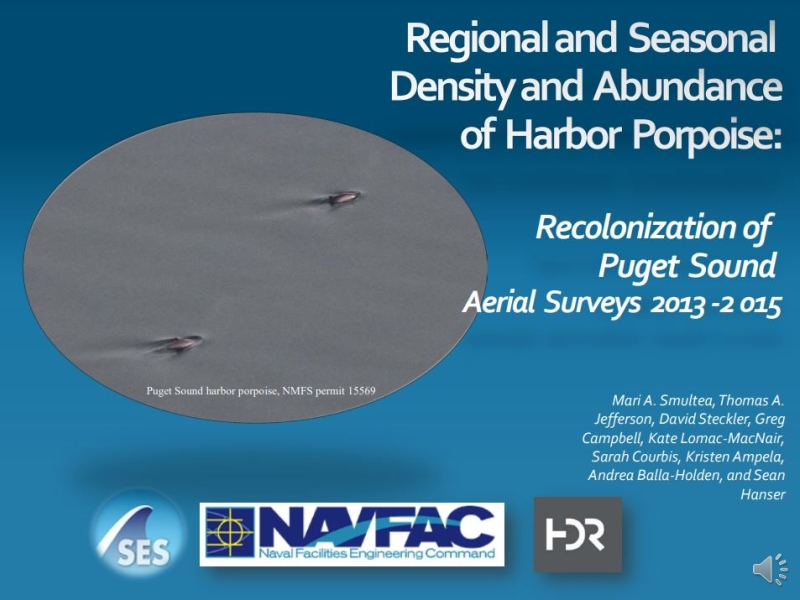
1) Conduct aerial surveys during four seasonal periods within the inland Puget Sound Survey Area to assess potential differences in seasonal distribution, numbers, and behavioral state patterns of marine mammals; 2) Collect data to estimate densities of marine mammals in the inland Puget Sound waters for species with sufficient sightings; 3) Estimate abundance for each marine mammal species seen an adequate number of times; 4) Document the distribution and habitat use of each species observed; 5) Document and describe behaviors seen without performing focal follows.
Complete
Characterizing the Distribution of ESA-listed Salmonids in Washington and Alaska
Project Objectives
Use acoustic tagging technology to provide critical information on spatial and temporal distribution of salmonids to inform salmon management, U.S. Navy activity, and Southern Resident Killer Whale (SRKW) conservation. The study seeks to 1) determine the occurrence and timing of salmonids within the Navy training ranges, 2) describe the influence of environmental covariates on salmonid occurrence; and, 3) describe the occurrence of salmonids in relation to SRKW distribution.
Complete
Guadalupe Fur Seal Satellite Tracking
Project Objectives
Determine the at-sea distribution of endangered Guadalupe fur seals and whether they travel through or utilize the offshore waters of the Southern California Range Complex and Northwest Training and Testing area
Current
Monitoring Cetaceans in Hood Canal
Project Objectives
This 12‑month integrated pilot project combines three complementary components: (A) shore‑based theodolite monitoring of harbor porpoises, (B) high‑bandwidth passive acoustic monitoring and soundscape characterization, and (C) suction‑cup multi‑sensor tag deployments on Bigg’s (transient) killer whales. Together, these data streams will quantify occurrence, movement, diving, and behavioral context for these two key species in relation to the local soundscape—including operational signals near the Dabob Bay Range Complex (DBRC) and the Bangor Trident Base. Results can provide an empirical foundation and inform the study design of future cetacean behavioral response studies (BRS) in Hood Canal.
Complete
North Pacific Humpback Whale Tagging
Project Objectives
Determine the occurrence, movement patterns, and residency patterns of multiple humpback whale Distinct Population Segments within Pacific Ocean Navy Range Complexes
Current
North Pacific Marine Mammal Species Distribution
Project Objectives
Develop a North Pacific-wide species distribution model for cetaceans
Complete
Occurrence of Green Sturgeon in Inland Waters (historical tag analysis)
Project Objectives
Compile green sturgeon tag and receiver data and analyze historical data for occurrence, distribution, and seasonality in Puget Sound and the Straits of Juan de Fuca
Complete
Offshore Distribution of Southern Resident Killer Whales in the Pacific Northwest
Project Objectives
1) Identify and classify Southern Resident killer whale (SRKW) detections from acoustic recorders and satellite tag tracking; 2) Develop a model to estimate the seasonal and annual occurrence patterns of southern resident killer whales relative to offshore Navy training ranges. 3) Characterize occurrence of anthropogenic sounds in potential SRKW habitat. 4) Develop state space habitat model for SRKW prey, based on fall Chinook salmon tagged released from California to British Columbia between 1977 and 1990 to estimate seasonal distribution along the west coast.
Current
Pacific Marine Assessment Program for Protected Species (PACMAPPS) survey
Project Objectives
Identify species of beaked whales, odontocetes, and baleen whales that occur in the surveyed areas; Monitor marine mammal and sea turtle presence, distribution, and diversity in offshore waters; Develop a better understanding of marine mammal distribution, movement patterns, habitat use, population structure, and abundance; Develop reference library of visually-validated acoustic recordings of marine mammals.
Current
Passive Acoustic Monitoring of Harbor Porpoises in Hood Canal
Project Objectives
This project was jointly funded through NAVSEA and the NUWC Keyport NISE program to address the Navy’s need for multi-year data on harbor porpoise occurrence and spatiotemporal distribution patterns in Hood Canal using passive acoustic monitoring (PAM).
Current
Salmonid and Southern Resident Killer Whale Distribution in the Pacific Northwest
Project Objectives
1) Determine the occurrence of bull trout within and near the boundaries of the NWTT; 2) Determine the spatiotemporal occurrence of killer whale and baleen whale in the NWTT; 3) Characterize the occurrence of endangered fish species within the NWTT
Complete
Satellite Tagging and Behavioral Monitoring of Male California Sea Lions in the Pacific Northwest to Assess Haul-out Behavior on Puget Sound Navy Facilities and Foraging Behavior in Marine Navy Testing and Training Areas
Project Objectives
To determine the abundance and habitat use of California sea lions that haul out at Navy facilities and forage in testing and training areas
Complete
Vessel-based Marine Mammal Surveys in Puget Sound, Washington
Project Objectives
Conduct marine mammal in-water vessel-based line transect surveys in the Puget Sound basin to: 1) Record data on all marine mammal species seen with the study area, with a focus on the killer whale (Orcinus orca) and the harbor porpoise (Phocoena phocoena). 2) Identify the seasonal occurrence and abundance/density of cetaceans within the study area. 3) Identify the effects of environmental variables on the distribution and abundance of species in the study area.No related blog posts to display